 Loading... Please wait...
Categories
 New Products
-
 $69.97
-
 $199.97
-
 $39.97
-
 $39.97
-
 $199.97
Our Newsletter
- Home
- Die-Cast Model Airplanes
- Corgi
- Rare AA33610 Corgi 1:72 RAF Panavia Tornado Wildenrath Model Airplane


)
Product Description
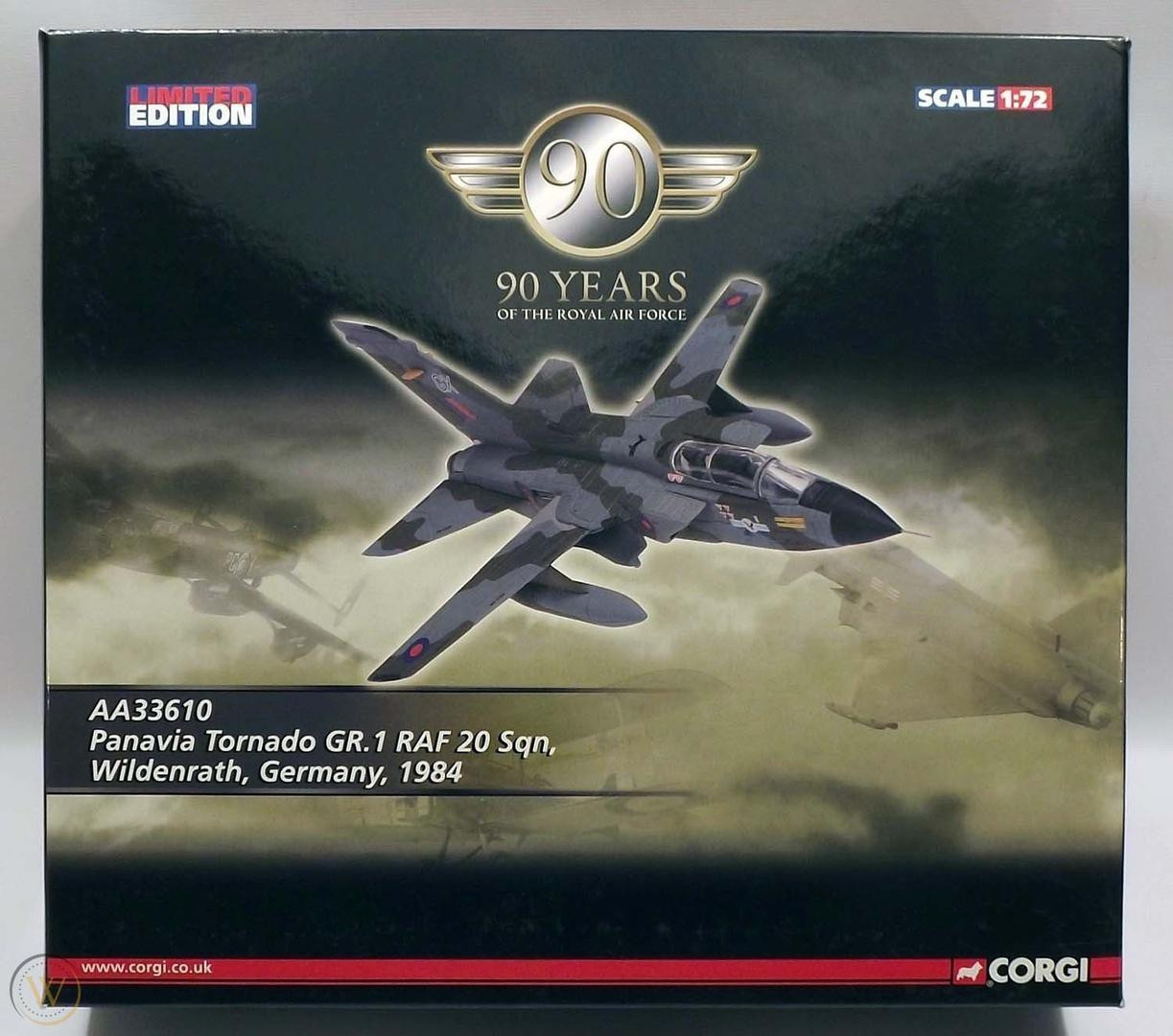
This is a 1:72 scale die-cast model airplane from Corgi Models of the Panavia Tornado GR.Mk 1 RAF No.20 Sqn, ZA367, RAF Wildenrath, Germany, 1984 This model si 9.25 inches long and has a wingspan of 7.75 inches. The Panavia Tornado was jointly developed by the UK, West Germany and Italy in three primary versions: The Tornado IDS (Interdictor/Strike) fighter-bomber, The suppression of enemy air defences Tornado ECR (Electronic Combat/Reconnaissance), and The Tornado ADV (Air Defence Variant) Interceptor. It is one of the world's most sophisticated and capable interdiction and attack aircraft, with a large payload, long range and high survivability. During 1984, No.20 Sqn re-equipped with Tornado GR1s at RAF Wildenrath, Germany, and these remained until the unit disbanded in May 1992. Designed in collaboration with Britain, West Germany and Italy, the Tornado was first flown on August 14th, 1974 and is thought by many to be the most important military aircraft in Western European history. Nicknamed "The Flying Fin" because of its large tail fin, the Tornado has a variable wing sweep design and is capable of taking off and landing on short airstrips. It is equipped with terrain-following radar, which allows for hands-off, low-level flight in any weather. There are three primary versions: an electronic combat/reconnaissance version, an interceptor and a highly versatile strike fighter-bomber capable of carrying almost all of NATO's air-launched weapons. Corgi's 1:72 scale Tornados feature the distinctively large tail fin that gives the real aircraft its nickname, The Fin. The model also incorporates the articulating swing-wing design that can be configured in varying sweep positions, movable elevators that rotate in unison, and simulated stainless-steel heat shielding around the detailed engine exhaust. The wing mounted fuel tanks and ordnance can be positioned to fit any swept-wing configuration, and the repositionable canopy opens to reveal pilot figures and cockpit detail, including the distinctive embedded cordite charge used to shatter the canopy during the ejection sequence. The mold itself is exceptionally rich in detail, with every access panel and antenna faithfully reproduced. Pad-printed unit markings and placards provide the finishing touches.
